
The Invisible Struggle – Understanding Concussions & Mental Health
Why Are We Talking About Head Injuries?
It’s easy to dismiss a bump on the head, but the reality is much more complex. In British Columbia alone, approximately 14,500 people visit the ER annually for concussions, yet awareness about the long-term effects remains surprisingly low. For students, this is a critical conversation. Research shows that about 40% of college students report having at least one concussion in their history.
Defining the Terms
Concussion: A mild traumatic brain injury (mTBI) caused by a hit or jolt to the body or head that temporarily alters brain function.
PCS (Persistent Post-Concussion Symptoms): When symptoms like dizziness, brain fog, and fatigue last weeks or months longer than expected.
TBI (Traumatic Brain Injury): An injury from an external force ranging from mild to severe, affecting physical, cognitive, and emotional function.
The Mental Health Connection
We often focus on the physical headaches, but the emotional toll is just as real. Students with a history of concussion show significantly higher rates of depression and anxiety compared to their non-injured peers. In fact, 20–35% of concussion patients develop depression or anxiety, a struggle that is rarely addressed in university settings.
The "Invisible" Injury
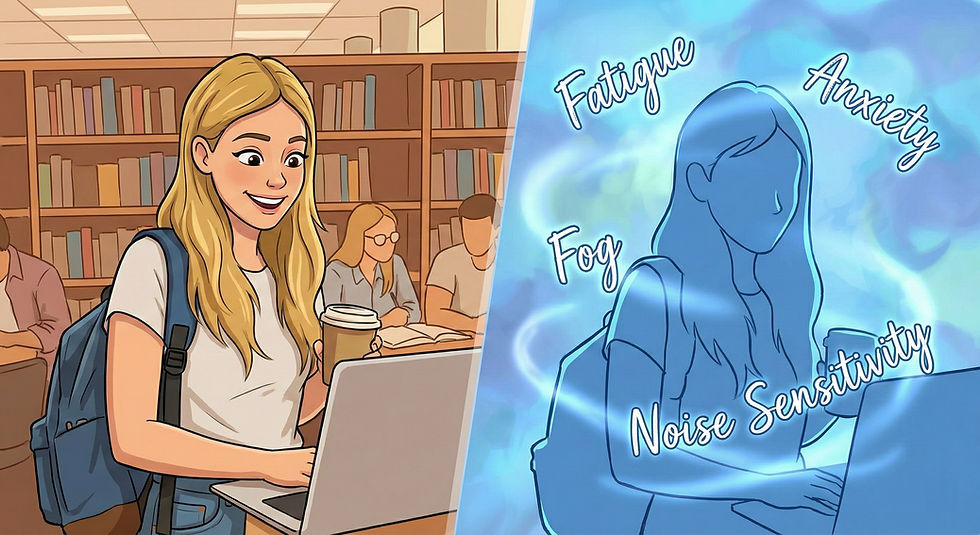
One of the hardest parts of recovery is the gap between how you look and how you feel.
What people see: You looking healthy, going to class, or grabbing dinner with friends.
What they don't see: The cognitive fatigue, pounding headaches, light sensitivity, sleep issues, and overwhelming anxiety that you are managing beneath the surface.
Key Takeaway: If you are feeling "off" or emotional after a head injury, you are not alone, and it is not "just in your head."
References
BC Ministry of Health. (2021). Concussion and traumatic brain injury emergency department visits in British Columbia.
Iverson, G. L., & Gardner, A. J. (2021). Concussion history and mental health outcomes in university students. Journal of Head Trauma Rehabilitation, 36(3), 180–188.
Silverberg, N. D., & Iverson, G. L. (2019). Mental health outcomes after concussion: A systematic review.
Centers for Disease Control and Prevention. (2024). Traumatic brain injury & concussion.


Comments