
Statistical Methods in Concussion Research
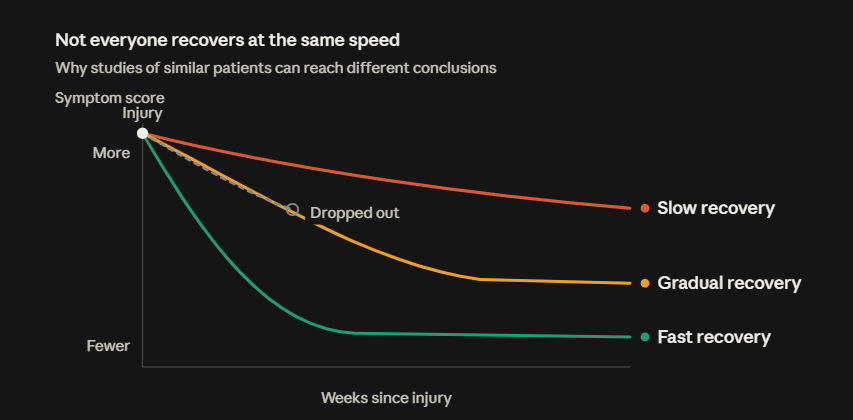
Concussion research is beset by unique challenges: highly heterogeneous patient samples, skewed concussion symptom data, participant attrition, and difficulties with longitudinal follow-up. As a result, two studies of similar populations can yield conflicting results. One contributing factor is researchers' statistical choices.
Using an appropriate statistical model yields accurate recovery timelines, identifies high-risk populations, and makes reliable risk predictions.
This blog breaks down common statistical approaches used in current concussion research.
Heterogeneity in Patient Samples
Concussion research often assumes a single recovery path; however, in reality, each individual follows a distinct process. Not everyone recovers at the same speed. Some resolve symptoms within weeks, while others struggle with persistent symptoms lasting for months.
To capture this diversity, group-based trajectory modeling (GBTM) and Latent Class Analysis (LCA) identify subgroups within datasets. Participants are sorted into distinct clusters based on how their symptoms change over time. After profile assignment, researchers treat each cluster as a new categorical variable and run analyses.
Skewed Concussion Symptom Patterns
PCSS (Post-Concussion Symptom Scale) and SCAT6 (Sport Concussion Assessment Tool 6) show strong floor effects and right-skewed distributions, with most patients showing minimal symptoms and only a small subset reporting severe symptoms.
For this reason, linear statistical methods fall short for analyzing concussion datasets.
Instead, the Mann-Whitney U and Kruskal-Wallis tests are used to compare two or more patient groups when the assumption of normal distribution does not hold. Since mean and standard deviation are sensitive to outliers, medians and interquartile ranges are used for interpretation.
Handling Missing Data
Participants are tracked from days to months and may miss appointments and drop out, making complete data difficult to obtain.
Survival models such as Kaplan-Meier curves and Cox Proportional Hazards regression are used to measure how quickly patients achieve return-to-play and return-to-learn clearance. These models accommodate incomplete data, accounting for partial information from participants who drop out before reaching the end of the study.
Conclusion
Selecting the right statistical methods is essential for making real progress in concussion research. By using specialized techniques to group similar patients, non-parametric tests to accommodate skewed symptom distributions, and survival analyses to account for missing patient data, researchers can track recovery far more accurately. These tailored approaches solve major complications like mixed patient results and participants dropping out of studies early.
Ultimately, stronger statistical choices help scientists map out realistic recovery timelines, identify vulnerable patients sooner, and guide better, personalized treatment plan decisions.
By Cindy Wang & Clara Suh
Members of Mind & Brain Student Network BC
References


Comments